

By Kelvin Paul
From the first lecture of Computer Introduction I said the word Computer comes from the term compute which means calculate, and I said then the computers originated from the concept of calculating devices. And of course Computers work with data and information in the form of numbers. People from the beginning of time, and throughout the years, have invented and continue to invent things that help them count. These tools have a very looong way back history beyond 4000 years ago when they only called them counting tools. Let’s talk about counting tools a little bit then we can have a stepping stone on a story of the History of computers.
From the first lecture of Computer Introduction I said the word Computer comes from the term compute which means calculate, and I said then the computers originated from the concept of calculating devices. And of course Computers work with data and information in the form of numbers. People from the beginning of time, and throughout the years, have invented and continue to invent things that help them count. These tools have a very looong way back history beyond 4000 years ago when they only called them counting tools. Let’s talk about counting tools a little bit then we can have a stepping stone on a story of the History of computers.
 ABACUS
Before 4000 years, man
kind used easily available tools to count like fingers and toys. Now you flash
back your life and remember when you started studing counting you used fingers,
then numbers got biger you mixed with your toies….and then…you found not enough
for larger numbers so you learnt to use other means, on my side I was using
match sticks my late brother Method G. Mgaya used to buy them for me and he was
teaching me counting before I started school. So you may experience a lot to
cover counting as the basic beginning for mathematics, ancients used even knots
on ropes and bones, But Approximately 4,000 years ago, the Chinese invented the
Abacus. It was the first machine used for counting and calculating.
Abacus was made of a
wooden frame, metal rods, and wooden beads. It takes a great deal of time and
practice to learn how to master the use of an abacus. It’s not easy as you
might think; Abacus was not a toy for kids to start studying counting it was a
professional tool used even in banks. Today, the abacus is still used widely in
China and other Asian countries to count and calculate, just as we use
calculators.

After the abacus
invention people worked so much harder to take counting to another level, and in
the early 17th century, John Napier, a Scottish mathematician, invented another
calculating tool. It used marked strips of wood or bone, side by side, to
multiply and divide. This tool became known as "Napier's Bones."
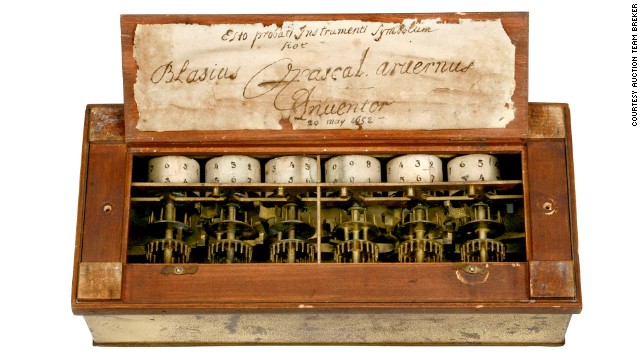
I love the story of Biaise Pascal and his automatic calculator, it
is very impressive. It was In 1642, at the age of 19, when this French
mathematician invented the Pascaline. He invented the Pascaline to help make
his father's job as a tax accountant easier. The machine is sometimes
called the La Pascaline or Pascal's machine. But I don’t know if I can say it
is sad or not that the Pascaline never became popular. You know
why?? May be these are the reasons, First of all, the machine broke often and
its inventor was the only person who could fix it. Second, it was slow. Third,
clerks would not use it: Guess what!! They were afraid it might replace them at
their jobs. But whatever the drawbacks he got, the guy was the first mathematician to make that Gear-Driven Machine for calculating work. And that is what is
so important, at least he did something for his father and something to talk
about today when we refer the legendaries who changed counting mechanisms. Generally the Pascaline is known as the first mechanical and automatic
calculator
 The Stepped Reckoner / Liebniz's Calculator
It was in 1673, when the
extraordinary German inventor Gottfried Liebniz brought out his Liebniz
Calculator. Liebniz was not that normal brained guy ofcause, he entered a
university at fifteen years of age and received his bachelor's degree at
seventeen. His machine is sometimes called The Stepped Reckoner. The
Liebniz was also a calculating machine, but much superior to that of the
Pascaline. It could do more than just add and subtract. The Liebniz Calculator
could also multiply, divide, and find square roots of numbers. It too was
mechanical and worked by hand. A crank was added to speed up the work of this
calculator. It was used by mathematicians and bookkeepers.
Mr. Liebniz believed
that it did not make sense for men to spend hours and hours doing mathematical
calculations when he could invent a machine that would work much faster.
 The
Jacquard's Loom
The
Jacquard's Loom
Now we are getting close
to our time somehow… this story contains sad part, but to this tough guy it was
just a backward force for an arrow before being released and go even much
further. In 1801, Jacquard invented the Jacquard loom. It was a weaving machine,
he used the punched cards to control it. While the loom was being pumped, cards
with holes in them were attached together in a pattern through which strings of
thread were automatically fed. These cards would feed the right pieces of
thread into the loom to make a beautiful cloth.
The sad part now,
Jacquard’s invention scared other weavers because it made cloth faster and
better than they could by hand. As a result, Jacquard's house and loom were
burned down.
This violent act did not
discourage Jacquard, for he built another loom. That is what a guy with
ambitions and visions acts, he was not a coward for he had vision where he
wanted to take a weaving industry to, which others saw it as a challenge and
not an opportunity. But what is funny and a happ ending ofcause is that,
Weavers still use the Jacquard Loom until today.
And if that is not
enough, in the years to follow, variations on jacquard's punched cards would
find a variety of uses, including representing the music to be played by
automated pianos and the storing of programs
for computers.
 Charles Babbage &
his Engines
Charles Babbage &
his Engines
Now, the great Mathematician
himself…
The computer as we know it today had its
beginning with a 19th century English mathematics professor name Charles Babbage.
In the early 1820s, an English mathematician by the name Charles
Babbage, designed a computing machine called the Difference Engine. This
machine was to be used in the calculating and printing of simple math tables.
In the 1830s, he designed a second computing machine called the Analytical
Engine. This machine was to be used in calculating complicated problems by
following a set of instructions.
The Analytical Engine
was a mechanical computer that can solve any mathematical problem. It uses
punch-cards similar to those used by the Jacquard loom and can perform simple
conditional operations.
However, neither
of these machines were ever finished because the technology at the time was not
advanced enough, and both of his projects lacked financial funding. The
computing machines made in the 1900s, and even those today are based on the
designs of the Difference Engine and the Analytical Engine. This is why Charles
Babbage is known as the "Father of Computers."
I can’t go on talking about how babbage inventions changes the
world we live today before sharing you this story, of a super woman in the
world of Programming.
 Augusta Ada Byron, Countess of Lovelace
Much of what we know
about Babbage and his machine comes from the papers of Augusta Ada Byron,
countess of Lovelace and daughter of the poet Lord Byron. Lady Lovelace was a
genius in math. curious about Babbage's work, she translated an article about
the analytical engine from French to English. She added some important notes of
her own about how the machine should work. She outlines the fundamentals of
computer programming, including data analysis, looping and memory addressing.
Lady Lovelace also
helped Babbage with programs for the Analytical Engine. Many of her ideas are
like those used in today's computer programs. Sadly, like Babbage, lady
Lovelace never lived to see her ideas used. She died at age 36 while Babbage
was still working on the Analytical Engine. Her work has long outlived her,
however. She is now called "the first programmer," and a programming
language used chiefly by the U.S. government was named Ada in her honor.
Much respect to all
ladies coding out there, Lucina Richard, Sarah, Sporah, and Brigta keep the
hard work.
Now let’s get into the
real mess took the world to another shell, Oh, something cool about computers, You
may not know this but Before Babbage came along, a "computer" was a
person, someone who literally sat around all day, adding and subtracting
numbers and entering the results into tables. The tables then appeared in
books, so other people could use them to complete tasks, such as launching
artillery shells accurately or calculating taxes.


Page 1
HIDDEN COMPUTER HISTORY.
 Reviewed by Electrotz
on
6:19:00 PM
Rating:
Reviewed by Electrotz
on
6:19:00 PM
Rating:
Reviewed by Electrotz
on
6:19:00 PM
Rating:


No comments: